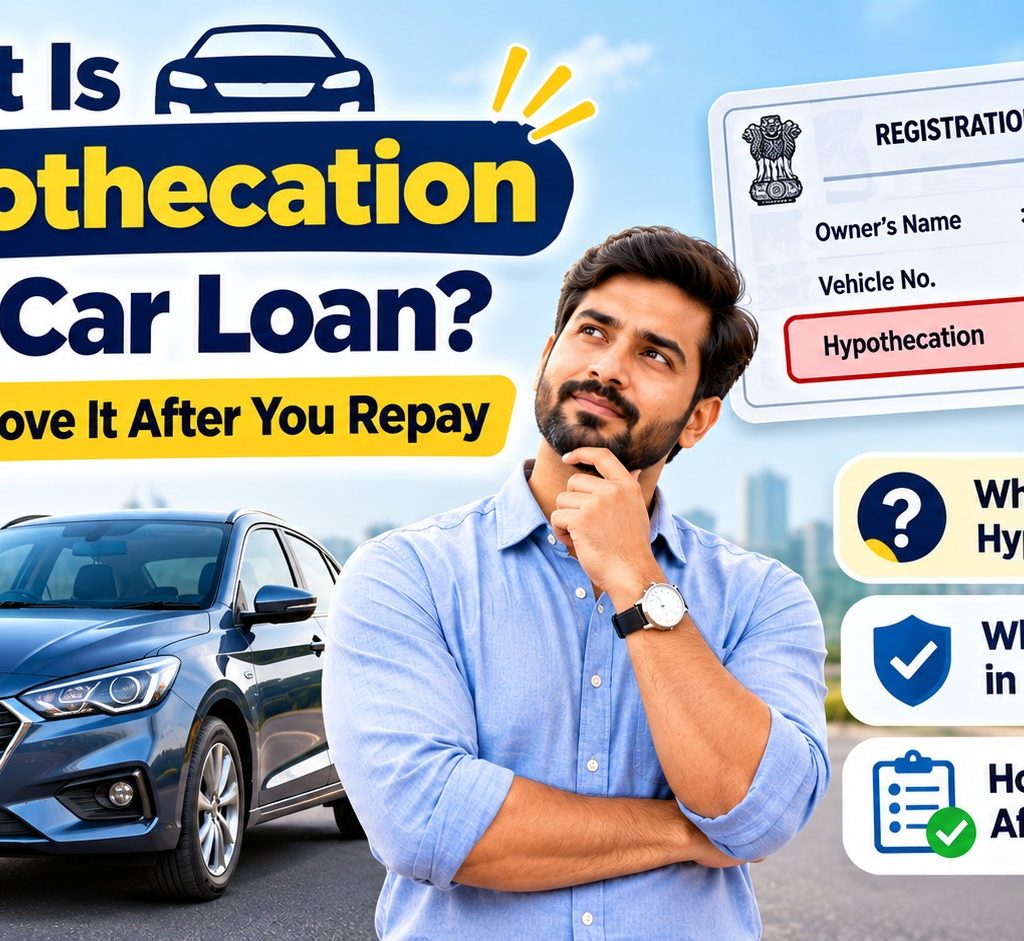
If you have taken a car loan, you may have noticed the word “hypothecation” on your car’s registration certificate (RC) or in your loan papers. Many buyers do not understand what it means until they finish repaying the loan and find that the entry is still there. In this guide, we explain hypothecation in a car loan in simple language: what it is, why it is added, and how to get it removed after you repay.
What Is Hypothecation in a Car Loan?
Hypothecation is an arrangement where the car you buy acts as security for the loan, but you keep using it. The lender does not take the car away. Instead, the lender’s name is recorded on your RC to show that it has a financial interest in the vehicle until you repay the loan in full. You remain the owner and continue to drive the car, but you cannot freely sell or transfer it without the lender’s consent.
Hypothecation vs Pledge vs Mortgage
| Term | Who holds the asset? | Typical example |
|---|---|---|
| Hypothecation | You keep possession and use the asset | Car loan, vehicle finance |
| Pledge | The lender holds the asset until repayment | Gold loan |
| Mortgage | Usually immovable property; the borrower generally keeps possession | Home loan, loan against property |
Why Is Hypothecation Added to Your RC?
- It protects the lender by recording its claim on the car.
- It prevents you from selling or transferring the car without clearing the loan.
- It lets the lender offer lower-risk, secured loan terms than an unsecured loan would allow.
This is the standard arrangement for most car loans, including new car loans and used car loans. It also applies to car refinance, which we explain in 5 Car Refinance Myths.
Does Hypothecation Mean the Lender Owns My Car?
No. You are the registered owner and you keep the car. The lender’s name is shown only as a financier with a claim on the car until the loan is cleared. If you miss repayments, the lender can take action as per the loan agreement, which is why timely EMIs matter.
How to Remove Hypothecation After You Repay the Loan
Repaying the last EMI does not remove the hypothecation entry automatically. You need to get it terminated. The exact process can differ by state and lender, but it generally follows these steps.
- Close the loan fully. Pay all EMIs, or foreclose the loan, and ask the lender for a loan closure or no-dues letter.
- Get the No Objection Certificate (NOC). The lender issues an NOC confirming that it has no further claim on the car.
- Get the termination of hypothecation form. Lenders typically provide a signed form, commonly Form 35, to end the hypothecation agreement.
- Apply to the RTO. Submit the form, the NOC, your RC and your ID proof to the Regional Transport Office where the car is registered. Some RTO services may also be available online through the Parivahan portal, depending on your state.
- Get the updated RC. After processing, the RTO removes the lender’s name and you receive an RC without the hypothecation entry.
Fees, documents and processing time vary by state and RTO, so confirm the current requirements with your lender and RTO before you apply.
Documents You May Need
- Original RC showing the hypothecation entry
- Loan closure letter or no-dues certificate
- NOC from the lender
- Signed form for termination of hypothecation (commonly Form 35)
- Your ID and address proof
- Insurance copy, if the RTO asks for it
Why Removing Hypothecation Matters
- Selling the car: a buyer cannot easily take ownership while the lender’s name is on the RC.
- Refinancing the car: a new lender will want a clean RC or a clear plan to clear the old entry.
- Clear ownership: it removes confusion about who has a claim on the car.
- Avoiding delays later: old paperwork is harder to arrange years later, especially if the lender has merged or changed.
Common Mistakes to Avoid
- Assuming the entry disappears automatically once the loan ends
- Losing the NOC or the signed termination form
- Waiting years before getting it removed
- Handing over originals to someone without a written acknowledgement
- Paying anyone extra money outside official fees without a receipt
What If You Moved to Another City or State?
If the car was registered in one place and you now live elsewhere, the process can take more steps. You may need to approach the original registering RTO or follow the procedure for a vehicle registered in another state. Check with your lender and the transport office early.
How Northwest Capital Can Help
With 26+ years of experience and 50+ bank and NBFC partners, Northwest Capital helps eligible customers across Pune and Maharashtra understand their loan terms from the start, including what paperwork to expect when the loan ends. If you are comparing lenders, read our post on bank vs NBFC used car loans.
Frequently Asked Questions
1. Is hypothecation the same as ownership?
No. You remain the owner. Hypothecation only records the lender’s claim on the car until the loan is repaid.
2. Is hypothecation removed automatically after the last EMI?
Usually not. You need to obtain the NOC and termination form from the lender and get the RC updated through the RTO.
3. Can I sell my car while the loan is running?
Only with the lender’s involvement. The loan generally needs to be cleared, and the lender’s NOC is required for ownership transfer.
4. How long does it take to remove hypothecation?
It depends on the lender and the RTO. Some steps are quick, while the RTO update can take time. Ask your lender and RTO for the current timeline.
5. Does hypothecation apply to used car loans and refinance too?
Yes. The lender’s interest is generally recorded on the vehicle for new car loans, used car loans and car refinance, until the loan is closed.
Have questions about your car loan paperwork? Talk to Northwest Capital for clear guidance before you decide. Contact us to get started.
Disclaimer: This article is for general information only and is not legal advice or a loan offer. Procedures, forms, fees and timelines for removing hypothecation vary by state, RTO and lender and may change. Please confirm the current process with your lender and the Regional Transport Office.